
Electrical & Electronics
Powered by
The B.E. in Electrical and Electronics Engineering (EEE) program at Acharya Institute of Technology fosters excellence in education, research, and innovation. The department delivers industry-relevant technical education designed to prepare students for core industries and future-ready careers. The programme offers a perfect blend of strong electrical fundamentals, electronics, programming, and emerging technologies. Students build a robust academic foundation in power systems and electrical machines while gaining specialized expertise in modern domains like Electric Vehicles and Smart Grids.
The program, in detail
Program Highlights
- Industry-Aligned Facilities: Features a specialized Centre of Excellence in Electric Vehicles (EV Lab) in collaboration with L&T Technology Services.
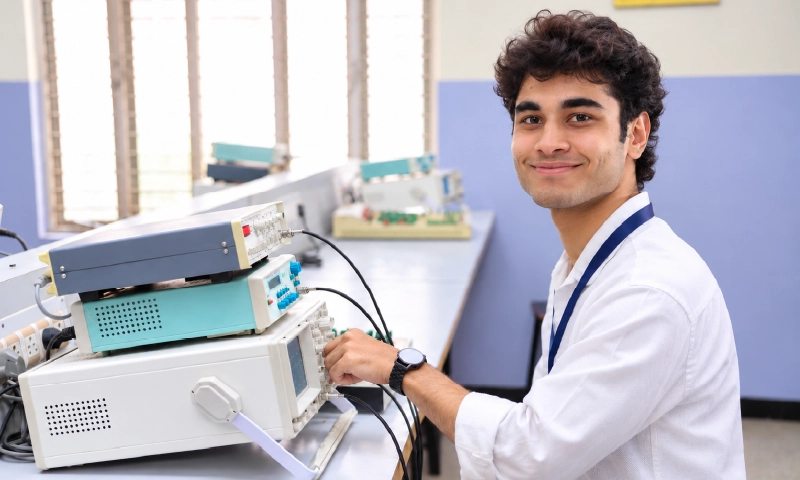
- Infrastructure: Access to modern equipment and practice-oriented laboratories for simulation and hardware prototyping.
- All-round Development: Active student bodies like ELEXO and the IEEE Student Chapter (PES) encourage technical, professional, and leadership skills.
- Future-Ready Curriculum: Integration of trending verticals such as AI applications in electrical engineering, Industrial Automation, and PLC–SCADA.
- Strong Industry Interaction: Continuous exposure through internships, industrial visits, expert talks, and Value Added Programs (VAPs).
- Expert Mentorship: Guidance from experienced faculty focused on preparing students for core engineering positions in global MNCs.
- Full Learning: A balanced focus on core electrical foundations, advanced programming, and emerging technology electives.
Research & Innovation
The department promotes a culture of excellence in research and innovation to address modern energy and automation challenges. You'll gain research exposure through:
- Faculty-guided capstone projects addressing real-world electrical engineering problems.
- Participation in the IEEE Student Chapter to stay updated on global research and technical standards.
- Innovation in Electric Mobility through the dedicated EV Lab in association with L&T.
- Industry-focused projects that bridge the gap between theoretical research and practical application.
- These opportunities strengthen analytical thinking and prepare
- students for high-level R&D roles and higher studies.
Experiential Learning
The program emphasizes practical, hands-on exposure through laboratories, simulations, and real-world projects. You'll gain hands-on experience through:
- Practice-oriented laboratories for Electrical Machines, Power Electronics, and Control Systems.
- Simulation and design tools including MATLAB, Multisim, PSpice, and Electrical Drawing software.
- Hardware prototyping using Arduino, ARM, Raspberry Pi platforms, and PCB design.
- Industrial visits and internships to gain first-hand experience of power plants and manufacturing units.
- Certification programs and skill labs that validate technical proficiency.
Academic Approach
The department provides a strong academic foundation combined with future-ready learning modules. Key academic practices include:
- Industry-integrated training via the Centre of Excellence in Electric Vehicles.
- Multi-disciplinary programming covering Python, Java, and Hardware Description Languages like Verilog and VHDL.
- Skill enhancement through value-added courses and hands-on training modules.
- Project-based learning focused on industrial automation and intelligent energy management.
- Electric Vehicles & EV Technologies.
- Renewable Energy Technologies & Smart Grids.
- Industrial Automation (PLC & SCADA).
- AI Applications in Power Systems.
Student Development & Activities
Beyond the classroom, students engage in diverse activities to build professional and leadership capabilities. The department regularly organises:
- ELEXO activities and technical events.
- IEEE Student Chapter (PES) seminars and workshops.
- Expert talks from industry veterans on emerging technology trends.
- Value Added Programs that provide specialized technical certifications.
- These initiatives help you build a competitive profile for global career opportunities and higher research.
Career Pathways
Electrical and Electronics Engineering offers diverse and high-demand career opportunities across core, public, and private sectors. Students find opportunities with Government & Psus such as BHEL, NTPC, KPTCL, KPCL, and Indian Railways. Leading private recruiters include global MNCs like Schneider Electric, ABB, Emerson Electric, and Hitachi Energy. The program also serves as a gateway to entrepreneurship and advanced research in India and abroad. Graduates can pursue roles such as:
- Design Engineer.
- Power Systems Engineer.
- Automation and Controls Engineer.
- Embedded Systems Engineer.
- EV and Battery Technology Specialist.
- Technical Consultant.
- Project Engineer.
- Electrical machines
- Power systems
- Power electronics
- Control systems
- Embedded systems
- Renewable energy
- Electric vehicle technology
Eligibility
Duration: 4 Years
Eligibility: 10+2 with PCM/PMC/PME + English, min 45%. Age 17+.
Entrance Quota: CET/ COMED K / JEE
