
Best Aeronautical Engineering College in Bangalore - Acharya
Our comprehensive Aeronautical Engineering program is designed to equip students with the knowledge, technical expertise, and problem-solving skills required to thrive in the dynamic aviation and aerospace industry. Students also gain exposure to advanced engineering tools and techniques through industry collaboration with Siemens. This ensures they stay aligned with the latest developments shaping modern aerospace technology at a leading Aeronautical Engineering college Bangalore.
Established in 2011 and affiliated with Visvesvaraya Technological University (VTU), the program focuses on the design, development, testing, operation, and maintenance of aircraft systems. The curriculum covers key domains such as aircraft design, aerodynamics, propulsion systems, and avionics, providing a strong balance of theoretical foundations and practical learning.
With rapid advancements in aviation technologies, unmanned aerial systems, and intelligent aerospace systems, the program prepares students to contribute meaningfully to the evolving global aerospace ecosystem, making it one of the best Aeronautical Engineering colleges in Bangalore.
Why Choose Aeronautical Engineering at Acharya?
- Industry-aligned curriculum covering aerodynamics, propulsion, avionics, and aircraft design
- Airbus A320 scaled flight simulator providing hands-on exposure to flight dynamics and aircraft operations
- Industry-certified training in Product Lifecycle Management (PLM) in collaboration with Siemens
- Exposure to advanced engineering tools including ANSYS, CATIA, MATLAB, SolidWorks, and OpenFOAM Opportunities for internships, industry projects, and global academic exposure
- Participation in aerospace competitions, innovation initiatives, and technical events
- Strong focus on project-based learning, research, and experiential training
Research & Innovation
The department actively promotes research and innovation through funded projects and academic collaborations.
The program has received prestigious Anusandhan National Research Foundation (ANRF) grants, including:
- A research grant of ₹44 lakhs (2024–2027)
- A major collaborative grant of ₹2.5 crore with the Indian Institute of Science (IISc) for the period 2025–2029
Experiential Learning
The program integrates classroom learning with extensive practical exposure to real-world aerospace applications.
Students gain hands-on experience through:
- Aircraft flight simulation and flight dynamics analysis
- Laboratory-based experimental learning
- Computational modelling and simulation
- Design-oriented mini and major projects
- Industry internships and technical visits
- Participation in aerospace innovation and design competitions
- The Airbus A320 scaled flight simulator facility enables students to understand aircraft handling, flight operations, and system performance in a realistic environment.
Academic Approach
The teaching-learning framework blends strong theoretical foundations with modern engineering practices.
The program incorporates:
- Structured classroom learning and tutorials
- Laboratory experimentation and testing
- Simulation and computational analysis
- Case studies and design-based assignments
- Continuous project evaluation and research engagement
Students also explore emerging domains such as:
- Computational Fluid Dynamics (CFD)
- Aerospace Structures
- Unmanned Aerial Systems (UAVs)
- Additive Manufacturing
- Artificial Intelligence in Aerospace Applications
Student Development & Activities
Students actively participate in a range of academic and technical activities designed to enhance practical understanding and professional skills.
These include:
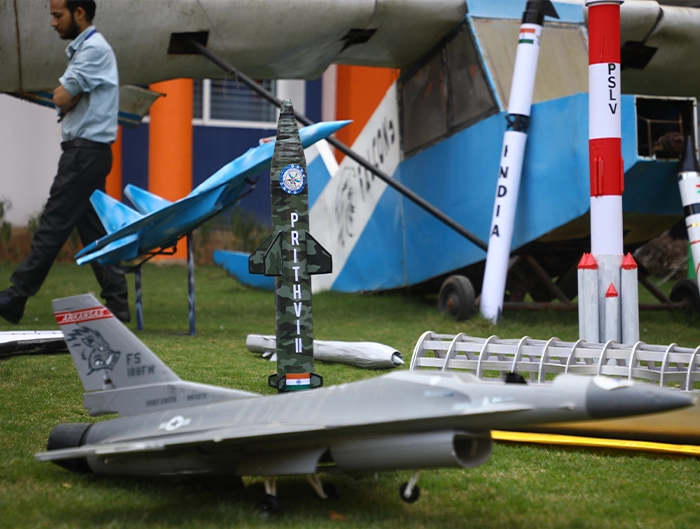
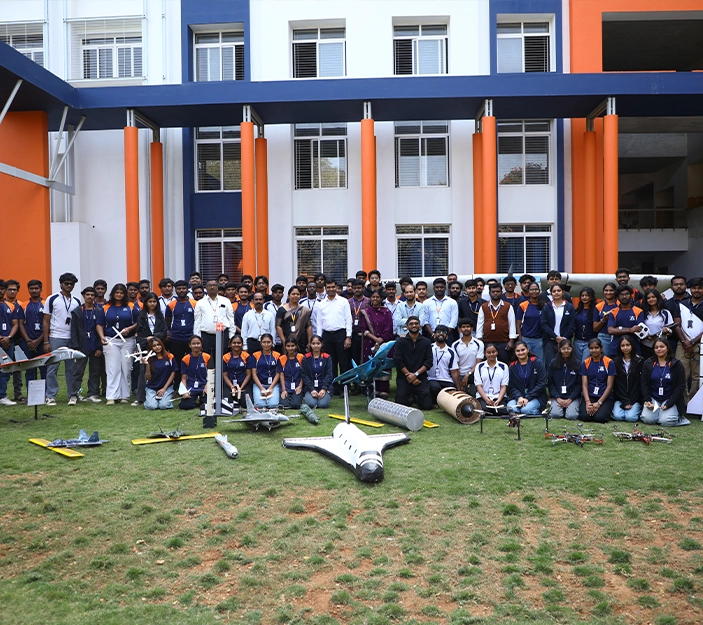
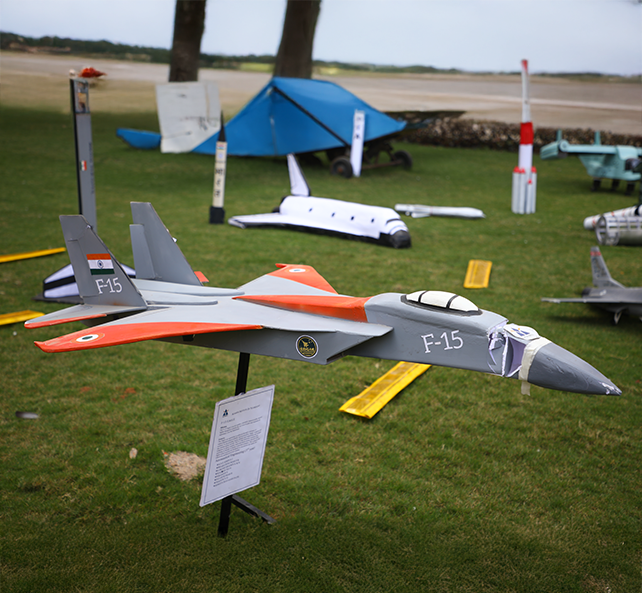
- Aeromodelling and aircraft design activities
- Technical workshops and value-added programs
- Innovation and entrepreneurship initiatives
- National and international competitions
- Technical paper presentations and conferences
- Industrial visits and internship opportunities
Faculty Expertise
The program is supported by a team of highly qualified and experienced faculty members with doctoral and postgraduate degrees from leading institutions including IITs, NITs, and reputed universities.
Faculty members combine academic excellence, research expertise, and industry exposure to provide students with strong conceptual foundations and real-world engineering insights.
Career Pathways
Graduates of Aeronautical Engineering have diverse career opportunities across aerospace, aviation, defense, manufacturing, and research sectors. They may pursue careers in leading organizations such as ISRO, DRDO, HAL, aerospace manufacturing companies, aviation technology firms, and global research institutions. Students also pursue higher education and research opportunities at premier universities in India and abroad.
Career roles include:
- Aircraft Design Engineer
- Aerodynamics Engineer
- Aerospace Systems Engineer
- Flight Test Engineer
- UAV Systems Engineer
- Aircraft Maintenance
- Operations Engineer
Overview
Duration : 4 Years
Eligibility : 10+2 with PCM/PMC/PME + English, min 45%. Age 17+.
Entrance Quota : CET/ COMED K / JEE
Inclusions: Tuition Fee, University Registration, Eligibility Fee, Miscellaneous Fee, Laboratory Fee, Library Fee and Sports Fee.
Exclusions : Uniform & Stationery.
Examination fee as prescribed by the University / Board.
Note : Students are offered complimentary Laptop, OBT, AMCAT/Cocube, Global Immersion Program, Softskill training, Domain training & Linkedin Learning Licence.
Frequently Asked Questions
Aeronautical Engineering is the study of aircraft design, aerodynamics, propulsion systems, avionics, and flight mechanics. It focuses on how aircraft are built, tested, and maintained to ensure safe and efficient flight operations.
Students must complete 10+2 (PUC or equivalent) with Physics and Mathematics along with Chemistry/Biology/Computer Science/Electronics and a minimum of 45% aggregate marks.
Admissions are offered through KCET, COMEDK, and JEE entrance examinations.
Students study aerodynamics, aircraft structures, propulsion, avionics, flight mechanics, materials engineering, and aircraft design along with core engineering fundamentals.
The department features advanced aerospace laboratories including a functional Wind Tunnel laboratory for aerodynamic analysis, aircraft simulation facilities, and avionics testing labs that provide strong practical learning.
Yes. All students are trained in Product Lifecycle Management (PLM) tools by Siemens, widely used in global aerospace and aircraft manufacturing companies for design, modelling, and lifecycle engineering.
Students receive practical exposure to aviation operations, including pilot training orientation and aircraft systems familiarization, helping them understand real flight operations beyond classroom learning.
Graduates can pursue careers in aircraft design, aviation maintenance, aerospace manufacturing, UAV/drone technology, defence research, space organisations, and aviation software engineering.
Yes. The institute provides placement training, internships, and industry interaction opportunities, preparing students for aviation, aerospace, and advanced manufacturing sectors.